
Method
A practical guide to taking medication on time
The dose people skip is rarely the 08:00 one. It is the 18:00 one, because 18:00 is cooking, collecting someone, or still at work. Missed doses are usually a problem of the moment, not of memory — and the moment is something you can design around.
This is not medical advice
Nothing on this page is clinical guidance. It is about routines and reminders, not about medicines. What to take, when to take it, what to do about a dose you missed, and whether a schedule can be changed are all questions for the person who prescribed it or for a pharmacist. If a medicine's timing is difficult to live with, that is worth raising with them — it is a common conversation, and the schedule can sometimes be adjusted.
Misses have a shape, and it is worth finding yours
If you keep a note for a fortnight of which doses you miss, a pattern usually appears within days. It is almost never random. One dose in the day is reliably the casualty, and it is reliably the one that falls inside a busy, moving, unpredictable part of the day.
Morning doses are usually the most reliable, because mornings have a fixed sequence: you wake in the same place, you make the same drink, you leave at roughly the same time. Evening doses are the least reliable, because evenings have no sequence at all.
Doses tied to being away from home are their own category. The lunchtime tablet fails on the days you are out, not on the days you are in — which means the fix is not a better reminder, it is a second supply in the bag.
Naming the pattern matters because each shape has a different repair. A dose you forget when the routine changes needs an anchor. A dose you forget when you are out needs a spare. A dose you remember and then put off needs a reminder that comes back.
The four reasons a dose gets missed
In everyday terms rather than clinical ones. Most people recognise one of these immediately as theirs.
The moment was wrong
The reminder arrived while you were driving, on a call, or halfway through cooking. You registered it and intended to do it in five minutes. Five minutes later the intention had been overwritten by whatever came next.
You were not where the tablets are
The medicine lives in the kitchen and you were upstairs, or at work, or out. Distance is a real cause of missed doses, and it is the one most easily fixed — usually with a second small supply rather than more willpower.
You genuinely could not tell whether you had taken it
This is its own failure, and it is uncomfortable rather than careless. Without something that records the act, the memory of taking today's dose is indistinguishable from the memory of taking yesterday's. Pill organisers exist entirely to solve this.
The reminder never reached you
The phone was silent for a meeting, face-down in a bag, or in another room. A banner notification has no answer to any of that — it fires once, into an empty room, and stops.
What to change, in order of how much it helps
Start at the top. The first two cost nothing and fix more misses than anything further down the list.
Anchor each dose to an event, not just a clock time
Pair the dose with something that happens anyway: the kettle, brushing your teeth, sitting down to eat, locking the front door. The clock time then becomes a backstop for the days the anchor moves, rather than the only thing holding the routine up.
Move the tablets to where you will be
The single most effective physical change. If the 18:00 dose is missed because you are never in the kitchen at 18:00, the tablets are in the wrong room. If the lunchtime one is missed on days out, put a few days' worth in the bag you always carry.
Make the act visible
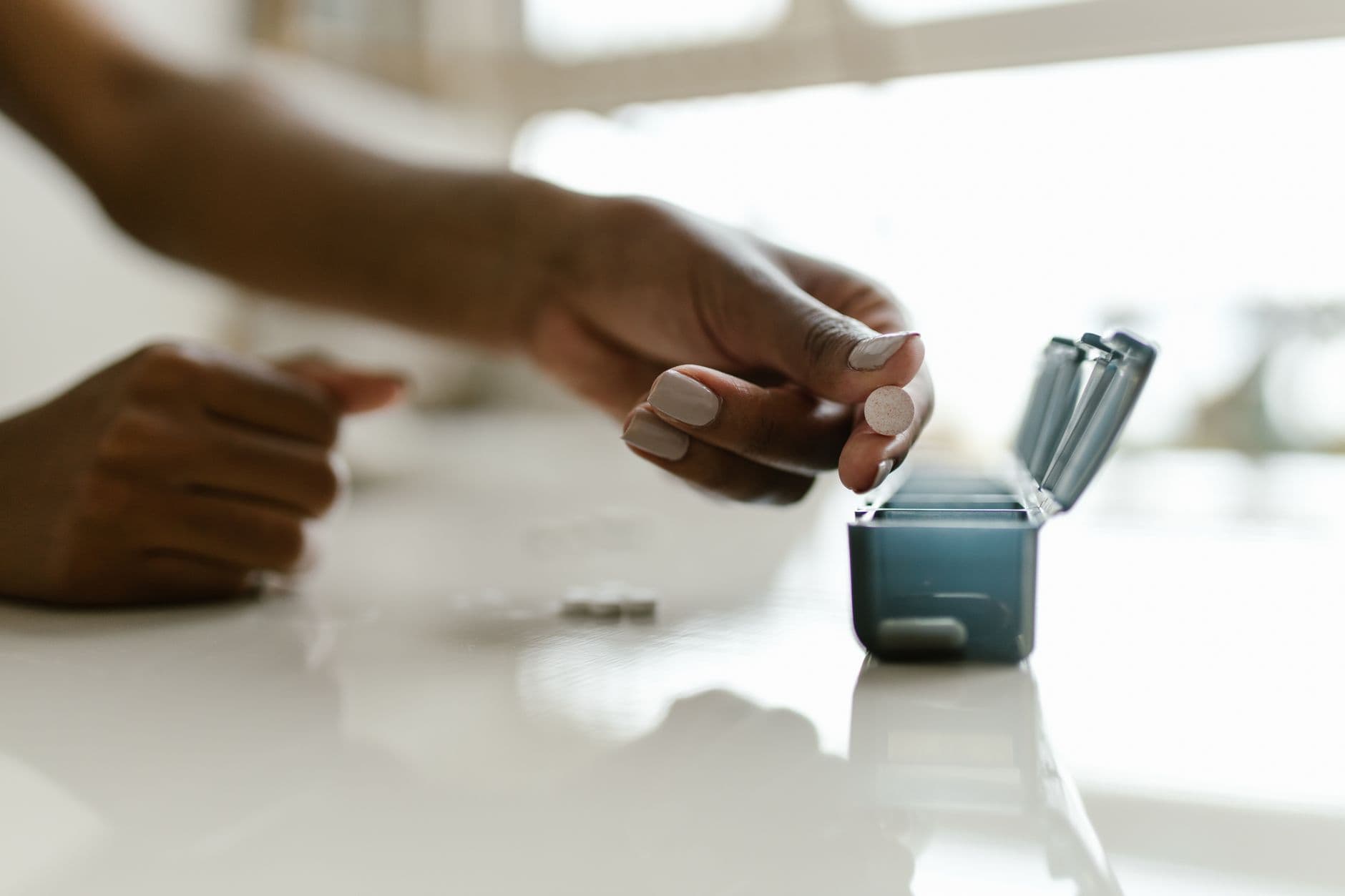
A weekly organiser, a box turned around, a tick on the calendar. You want a state you can look at rather than a memory you have to interrogate. This is also what turns "did I take it?" from a worry into a glance.
Set the reminder for the anchor, not the round number
07:45 when the kettle goes on, not 08:00 because it is tidy. Round numbers are convenient for setting up and slightly wrong for every single day afterwards.
Give the difficult dose a louder channel than the easy one
The morning dose almost never needs more than a quiet alert. The one you keep missing is the one worth escalating — and only that one, because a reminder that shouts about everything gets muted within a fortnight.
Set the repeat to end when the course does
A ten-day course should stop after ten days on its own. Setting the end condition at the moment you create the reminder means you never have a reminder ringing for a medicine you finished in October.
When the reminder itself is the weak link
If your misses are mostly the fourth kind — the reminder fired and you were not in a position to see it — then no amount of routine design will help, because the routine is fine and the delivery is broken. This is the category where the choice of tool actually matters.
The useful properties are specific. A reminder that behaves like an alarm rather than a banner, so it is not clearing itself alongside nine other things. A reminder that comes back if you do not acknowledge it, rather than firing once into an empty room. And, for the dose that genuinely matters, a channel that does not depend on the phone being unlocked, in the room, or even holding a charge on an app.
Timelee is built around that last point. A medication reminder holds the medicine's name, type, colour, a photo of the box and the dose per time, with several times a day and Morning, Noon, Afternoon, Evening and Night presets. Its delivery can be set as high as a real phone call placed to a number you have verified, which rings on the phone network whether or not the app is running. The nag setting, which the app calls Pinch Me, re-rings on an interval instead of once — useful for the dose you acknowledge and then put down.
None of that changes what a dose does or when it should be taken. It changes only whether you were told, at a moment you could act, in a way you noticed.
When the doses are not yours
Reminding somebody else is a different problem, and the difficulty is usually social rather than technical. A reminder from you arrives as a message from a person, and repeated messages about medicine can start to feel like supervision even when they are meant as help.
A phone call is often the better shape here, for a practical reason: an older relative who finds app notifications hard to notice will almost always answer a ringing phone, because answering a ringing phone is a lifetime habit. It also needs nothing installed at their end.
Timelee will only call a number whose owner has verified it with a one-time code, which is the answer to the obvious worry about automated calls. It also means this has to be set up together rather than done to someone — which, in practice, tends to produce a better arrangement anyway.
- A call needs no app at the other end
- Numbers are verified with a code before anything can ring them
- Agree the times with the person, not for them

Common questions
What should I do if I miss a dose?
Ask a pharmacist or the person who prescribed it. The right answer depends entirely on the medicine, and it is genuinely different from one to the next — this is not something a reminder app or a web page can answer for you.
Do reminder apps improve adherence?
We are not going to quote you a figure, because we have not run a study and repeating someone else's out of context would be worse than saying nothing. What we can say plainly is what a reminder can and cannot do: it can address forgetting and timing, and it cannot address cost, side effects, or not wanting to take something. Those need a conversation with a clinician.
How do I stop reminders for a course that has finished?
Set the end condition when you create the reminder rather than planning to come back. A repeat can be set to end after a specific number of runs, which matches how courses are usually prescribed, or on a date.
Can I get a reminder that keeps going until I actually take it?
Yes. Timelee's nag setting re-rings on an interval instead of once. Some intervals repeat a set number of times and stop; the every-minute and every-day settings continue until you mark the reminder done. Use it for one dose, not all of them.
Can someone else see whether I took it?
Not automatically. Completed reminders go to your own history, which is useful when you want to check what happened yesterday. Sharing is explicit: a shared reminder is one you deliberately send to another person, who accepts or declines it.
Is Timelee approved for healthcare use?
No. Timelee holds no healthcare certification of any kind, and it is not a medical device or a clinical tool. It is a reminder app, and this page is about routines rather than treatment.
Start with the one dose you actually miss
Not the whole schedule. Find the dose that fails, anchor it to something that happens anyway, move the tablets to where you will be, and give that one reminder a channel you cannot swipe past.
Keep reading
- Medication remindersDose, photo of the box, and times of day with presets.
- Missed doses as a delivery problemThe same subject, from the app's side.
- Medication reminder apps comparedWhat to look for, category by category.
- Reminders for carersWhen the schedule you are running is someone else's.
- Nag remindersFor the dose you acknowledge and then put down.